
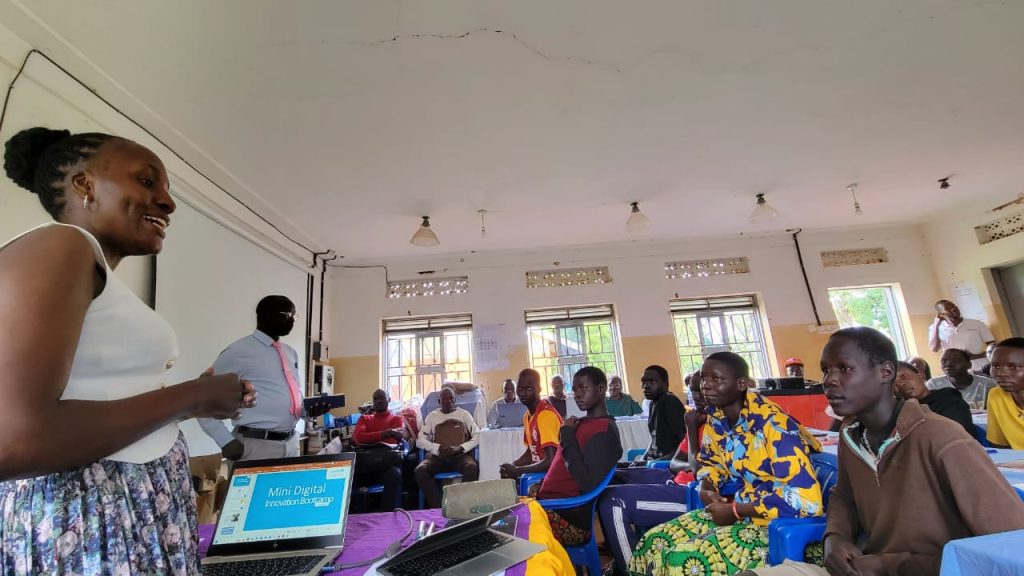
I recently had the privilege of conduct a transformative five-day “Mini Digital Innovation Bootcamp” in Lamwo, Uganda. The experience was a powerful reminder of the untapped potential within our youth. This is a diverse group including students, and resilient young people living in refugee settlement camps who left school early.
This was not just a training session but also a launchpad for social change, blending UNICEF Digital Skills Modules with the proven UPSHIFT social innovation process.
A Curriculum for the 21st Century
The bootcamp centered on the i-UPSHIFT methodology, a social innovation and entrepreneurship program designed specifically for marginalized youth integrated with the digital skills tool kit. The core architecture of the curriculum centered on equipping marginalized youth with essential 21st-century skills which include;
- Problem-solving
- Critical thinking
- Creativity and Creative confidence
- Communication,
- Leadership and Teamwork
- Hope for the future
- Identity/self-esteem
- Digital skills and Innovation
Learning Digital by Innovating Philosophy | Moving Beyond Paper
For years, classic workshops have relied heavily on physical markers, flip charts, and cardboard boxes to map out ideas. In Lamwo, we completely disrupted this model. We championed a “learn digital by innovating” philosophy. Instead of paper, these brilliant young minds naturally adopted a diverse toolkit of information and communications technology (ICT) software to execute every stage of their design thinking journey.
In today’s world, digital literacy is a necessity, not a luxury. We adopted a “learn digital by innovating” approach where Participants didn’t just hear about technology but they used it to solve real-world community challenges.
On a daily basis we used different digital tools to bring life into the entire training and some the tools include:
- Google Forms & Google Sheets. These were mastered by participants to build survey tools, publish questionnaires, and aggregate user research data automatically.
- Canva. This acted as the ultimate creative canvas for rapid digital prototyping and user-persona sketching.
- Microsoft Word: this was employed to structurally draft comprehensive solution summaries, operational tools, and project locations.
- AI Tools (such as ChatGPT) were used responsibly by groups to explore advanced digital pathways, analyze options, and bounce innovation ideas.
- Mentimeter. This was used on day one to collect participant expectations, capture initial strengths, and reflect interactively in real time.
- Kahoot was utilized for gamified baseline assessments and ongoing daily quizzes, introducing a healthy sense of fun, team recall, and friendly competition.
- Microsoft PowerPoint. This substituted traditional poster boards, allowing teams to digitally design complex “Problem Trees”, build Stakeholder Maps, and organize pitch slides.
The Methodology
The five-day innovation journey from Problems to Prototypes followed a rigorous methodology.
- Observe and understand: Participants used “Problem Trees” and the “5 Whys” technique to dig beneath the surface of community issues and identify root causes.
- Design: Teams reframed challenges into “How Might We” statements, moving from problem-finding to solution-seeking.
- Build and test: Using limited resources, teams built simple prototypes and conducted user research to see if their ideas truly worked.
- Make it Real: The bootcamp resulted in a “Pitch Deck” presentation where teams showcased their final solutions to their peers and facilitators.
Cultivating Digital Safety
As a digital skills master trainer, I recognize that expanding digital access without expanding safety protocols leaves vulnerable youth exposed. Therefore, a core component of our integration was anchoring innovation within digital Safety boundaries.
During our user-research setup, problem identification, and tool training, we deliberately held spaces to educate the youth on critical cyber-hygiene, which included;
- Combating Cyberbullying which addresses online harassment, which the youth themselves identified as a prominent threat in their communities.
- Data Privacy & Survey Etiquette. Learning how to handle user data securely when publishing Google Forms without exposing sensitive or personal beneficiary details.
- Responsible AI Use. Ensuring AI tools are utilized as collaborative brainstorming mechanisms rather than sources of unverified plagiarism.
Navigating the Ground Realities
Running an advanced digital bootcamp in a remote environment came with tangible hurdles. Several teams initially faced limited access to working physical devices, requiring local institutional instructors to generously loan their personal laptops so every team could co-create digitally. Technical glitches and intermittent internet connectivity meant adjusting paces on the fly.
Yet, watching a participant who had never seen a Google Form a day prior take the stage to confidently teach their peers how to link data variables to a spreadsheet was proof enough that constraints do not limit capability.
Call to Action for EdTech Educators
The massive success of the bootcamp proves that when you provide youth regardless of whether they are native students or young people inside a refugee settlement camp, with an intersection of digital tools and mental innovation frameworks, they don’t just learn technology. They lead social transformation.
The bootcamp is merely the starting line. Moving forward, these young “Idea Catalysts” require sustained mentorship, tech clubs, and incubation pathways to convert these Canva and PowerPoint prototypes into scalable social enterprises. Let us continue to invest our resources into building a resilient, digitally safe, and youth-led innovation ecosystem across Uganda.
When you give young people the right tools, both digital and mental they don’t just learn; they lead. Whether they are in school or in a refugee settlement, their “superpowers” of creativity and critical thinking are the keys to building a more resilient Uganda.
As educators, innovators, and changemakers, our challenge is to completely dissolve the boundary between “traditional thinking” and “digital execution.” We must encourage a mindset where digital tools are as natural as breathing. Let us commit to pushing the boundaries of every concept we conceive, ensuring that every spark of human creativity is matched with the infinite power of digital connectivity. The next generation is ready to build and it is our responsibility to hand them the digital tools to make their blueprints permanent.
Published by Katusiime Apofia
IT Specialist | Education Technology Coach | Digital Inclusion Advocate |DST Master Trainer

Leave a Reply